SaaS product growth
Five SaaS product improvements that actually compound
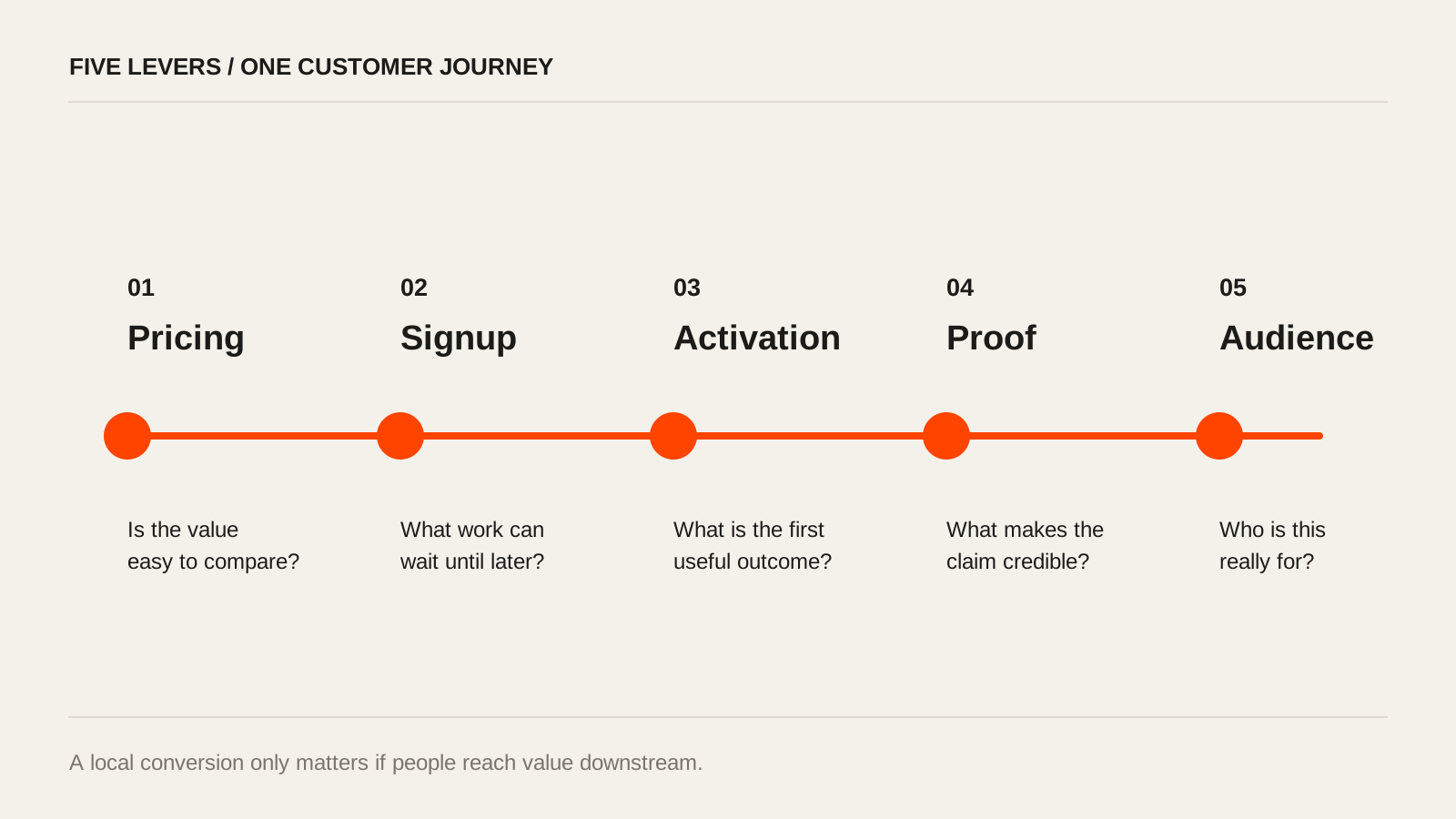
Pricing, signup, activation, proof and audience fit are connected decisions. Here is how I would find the smallest useful change in each one.

Small changes are only useful when they change a decision
“Five ways to grow your SaaS” sounds easy. Change the price, shorten the form, add a product tour, collect testimonials, define a persona. I have seen teams do every one of those things and still leave the central problem untouched: the right customer cannot see what the product will do for them, or cannot reach that value once they sign up.
The original version of this article named five useful levers. I still use them. The difference in this version is the question behind each lever: what hesitation are we removing, and what evidence would tell us the change worked? You do not need a new growth dashboard to begin. You need a clearer view of the journey already in front of you.
1. Revisit pricing as a product decision
A price page is an explanation of value. If a buyer cannot tell why one plan costs more, changing the number alone will not solve the problem. Look at what customers actually value: seats, projects, usage, time saved, risk reduced or a service level. The right value metric should become clearer as the customer succeeds.
Start with three pieces of evidence: which plan prospects ask about, which limits paying customers hit, and which pricing questions stall a sales conversation. Then check whether plan names, limits and upgrade moments describe meaningful differences. If the customer needs a call to understand a basic plan, the page has work to do.
Annual plans can help cash flow, but they also ask for more trust upfront. Explain the commitment, cancellation terms and support level plainly. Treat a price change as an experiment in comprehension and fit, not a guaranteed revenue lift.
2. Remove signup work that belongs later
Every field is a request for attention. Ask only for what someone needs to take the next useful step. If company size, phone number or card details are not needed before the first outcome, test moving them closer to the moment they become relevant.
Imagine a fleet manager trying a dashboard between meetings. They need to see a sample fleet and understand the first task. A long company profile form tells them nothing about the product. A shorter path might help, but do not mistake “fewer fields” for the whole solution. The promise before signup, the first screen after it and the recovery path for a failed email are all part of the same flow.
Measure completed signup alongside qualified activation. A frictionless entrance that brings people to an empty, confusing workspace has merely moved the drop-off.
3. Design onboarding around a first meaningful outcome
A tour tells people where features live. Activation happens when they use one to make progress. Choose the first moment that would make a new customer say, “Now I understand why this is useful.” Then design the shortest credible path to it.
For a team tool, that might be inviting a colleague and completing one shared task. For an analytics product, it might be connecting a source and seeing a trustworthy first answer. For fleet software, it might be finding a vehicle that needs attention and taking the next action. The moment depends on the job, not on the number of tooltips you can write.
Use email, in-product guidance or human help where each adds context. A welcome sequence cannot rescue a first session that never shows value. A live chat bubble cannot replace a clear information hierarchy.
4. Put proof beside the claim it supports
“Trusted by teams” is easy to write. A specific customer story is harder and more useful: who had the problem, what changed in the work, and what evidence can be shared. Place that story where a buyer is making the matching decision. A case study about complex data belongs near the product capability it demonstrates; a quote about partnership belongs near the service model.
Use permissioned names and honest context. Do not turn a customer's result into a universal prediction. If the strongest proof is a product walkthrough rather than a metric, show the walkthrough. Credibility grows when the claim and the evidence are close enough to examine together.
5. Narrow the audience until the message gets sharper
“For growing businesses” can mean almost anyone. A useful audience description captures the situation that makes the problem urgent: the team, its current workaround, the cost of that workaround and the decision it needs to make. This should shape the website, onboarding examples and sales conversation.
Talk to customers who stayed and those who left. Look for the jobs they were trying to complete, not just their company size. A smaller segment with a clear problem can be easier to serve well than a broad category that forces every feature to speak to everyone.
| Lever | Question to ask | Signal to watch |
|---|---|---|
| Pricing | Can buyers explain the difference between plans? | Qualified plan selection and upgrade conversations |
| Signup | What do we ask before someone can see value? | Signup completion and qualified activation |
| Onboarding | What is the first meaningful outcome? | Time to that outcome and return usage |
| Proof | Which claim still feels unearned? | Buyer questions, case-study engagement and sales objections |
| Audience | Which customer situation is clearest to serve? | Retention and fit by use case |
Choose one lever, then follow it through
I would not launch five experiments at once. Find the sharpest hesitation. Write what you expect to change, make one meaningful revision, and watch what happens at the next step. If more people sign up but fewer reach first value, the journey is telling you something. If fewer people start but more of the right customers stay, that is worth understanding too.
The small things can make a big difference. They do it when they are connected to the work a customer came to do.