Product research
User research is a way to reduce decision risk
The value of research is not the volume of notes a team collects. It is the uncertainty removed from a consequential product decision.
Research begins where confidence and evidence separate
Teams rarely lack opinions. They lack a shared way to decide which opinion deserves investment. User research makes uncertainty visible before it becomes expensive code, confusing content or an operational burden.
Frame the work around decision risk: what must the team decide, what could be wrong, who would experience the consequence and what evidence would change the choice? “Understand our users” is too broad. “Decide whether people can safely resume a partially completed identity check” creates a researchable boundary.
Risk can sit in desirability, comprehension, ability, trust, operational feasibility or unintended harm. Name it. A method is only useful in relation to the uncertainty it can reduce.
Choose the method for the question
| Method | Best used to learn | Weak when used alone |
|---|---|---|
| Interviews | Language, memories, expectations, reasoning and perceived constraints | Predicting exact future behaviour or proving prevalence |
| Observation | What people do in context, including workarounds and environmental constraints | Explaining motives without follow-up conversation |
| Usability testing | Whether a person can understand and complete a defined task with an interface | Proving product-market demand or population-wide preference |
| Surveys | Patterns in self-reported attitudes or experience across a defined sample | Discovering an unknown problem or observing behaviour |
| Support evidence | Recurring pain, language, failed expectations and recovery needs | Representing people who never contact support |
| Analytics | What happened in an instrumented product and where patterns change | Explaining why it happened without complementary evidence |
What people say and what people do answer different questions
What people say reveals vocabulary, belief, expectation and remembered experience. What people do reveals strategies, interruptions, workarounds and the real sequence of action. Neither is inherently more honest; they are evidence about different things.
If someone says security is their highest priority and repeatedly chooses the fastest path, do not label the person inconsistent. Examine the context. The cost may be distant while the delay is immediate. The interface may make the secure option harder to recognise. Research should explain the tension rather than choose the evidence that supports the team’s preferred story.
Preserve the chain from observation to decision
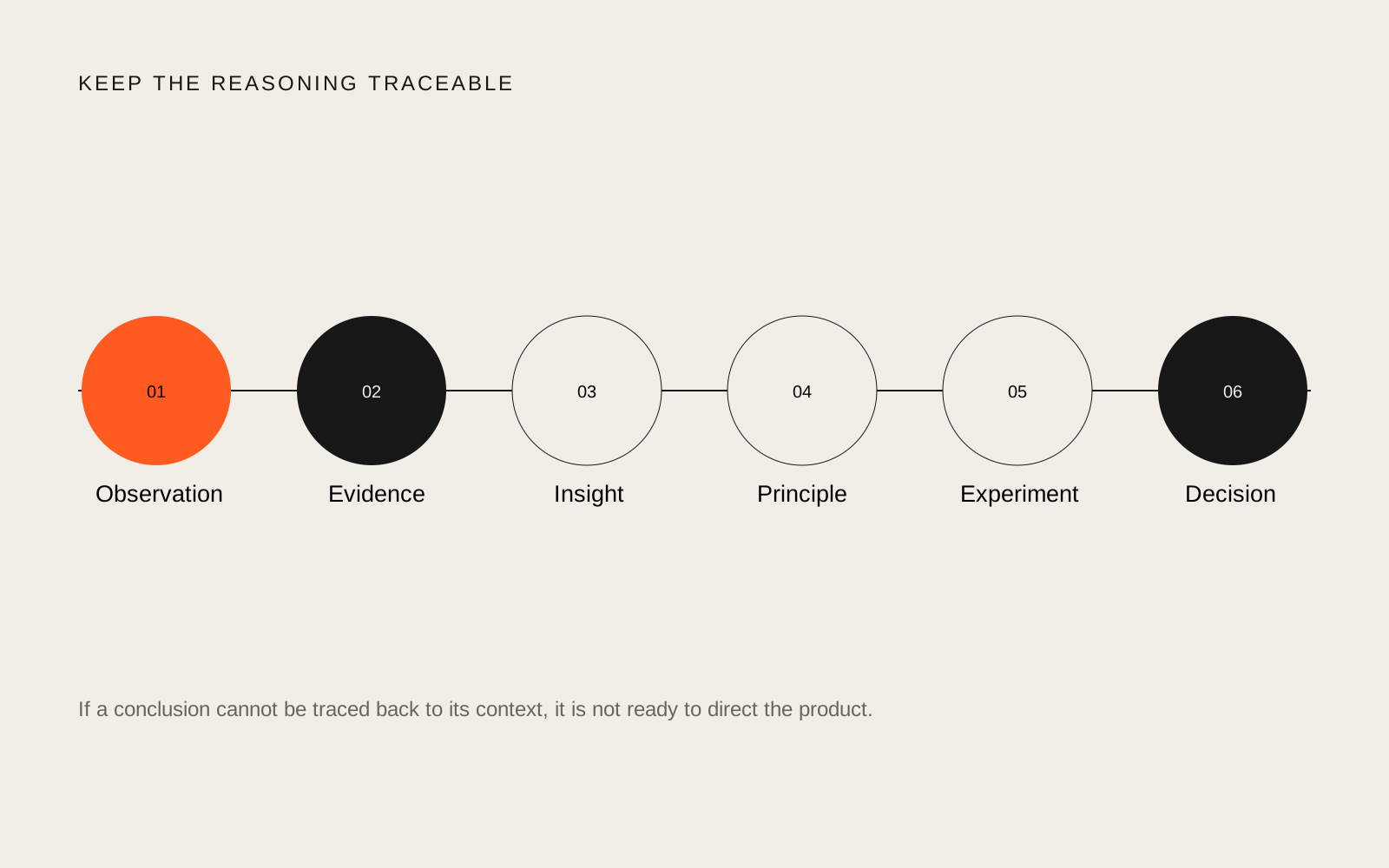
Observation → Evidence → Insight → Principle → Experiment → Decision
An observation records what happened: “Three participants opened the help panel after the document upload failed.” Evidence combines relevant observations with source context. An insight proposes meaning: “People interpret an unexplained upload failure as a document problem rather than a connection problem.” A principle guides a family of responses. An experiment changes the interface so the interpretation can be tested. The decision states what the team will now do.
Jumping from a quote directly to a feature loses the middle of the chain. It also makes future disagreement impossible to resolve, because nobody can see whether the insight came from repeated behaviour, one vivid comment or an assumption added later.
A decision-ready research cycle
Frame the risk
Name the decision, user consequence, existing evidence and what would change the choice.
Select and recruit
Choose a method and participant criteria that match the behaviour or context in question.
Collect without teaching
Use neutral tasks and prompts; preserve source, context and exact behaviour.
Analyse together
Cluster evidence, seek contradictory cases and separate observation from interpretation.
Change the product decision
Assign an owner, make the design response explicit and document remaining uncertainty.
Include the people most likely to meet the barrier
Average users do not exist. Recruit for relevant behaviour and include people whose access needs, devices, language, confidence or environment can expose a brittle assumption. A flow that succeeds only on a recent phone, with perfect vision and uninterrupted attention, is not a dependable flow.
This does not mean every small study represents everyone. It means the team is explicit about who participated, who did not and whose risk still needs attention. Research ethics, consent, privacy and the handling of sensitive information are part of method quality—not an administrative appendix.
Treat contradictory evidence as useful
Contradiction may reveal different segments, contexts or stages in a journey. One person may want guidance because the task is unfamiliar; another may find the same guidance obstructive because they repeat the task daily. The product decision may be progressive disclosure rather than choosing one person’s preference.
Record disconfirming cases. Ask what evidence would make the current insight wrong. A research readout that contains no uncertainty usually hides the uncertainty rather than resolving it.
A useful readout ends with action
The team needs a concise record: the decision, participants, method, evidence, insight, product implication, owner and remaining risk. Clips and quotes can bring context into the room, but they should not substitute for traceable reasoning.
Research has done its job when the team can say: because we observed this pattern in this context, we will change this part of the product, measure this outcome and revisit this uncertainty. That is more valuable than a library full of findings nobody can connect to the next decision.
Sources and further reading
- GOV.UK Service Manual: User researchA practical hub covering inclusive, continuous research across service design.
- GOV.UK Service Manual: Contextual research and observationGuidance for understanding behaviour in context.
- GOV.UK Service Manual: Analyse a research sessionA useful baseline for collaborative, evidence-led analysis.